
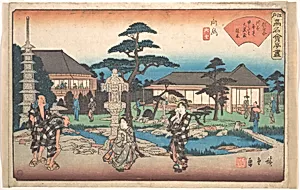
Mukōjima (Daikokuya)|江戸高名会亭尽 向島 大七|The Daikokuya at Mukojima
ca. 1835–42
Medium
Woodblock print; ink and color on paper
Dimensions
H. 9 5/16 in. (23.7 cm); W. 14 3/16 in. (36 cm)
Classification
Prints
Culture & Period
Japan · Edo period (1615–1868)
Department
Asian Art
Museum
Metropolitan Museum of Art, New York, NY
Credit
Rogers Fund, 1919
Accession Number
JP1161
Rights
Public Domain
Tags
Art Historical Context
Utagawa Hiroshige1797–1858), a master of ukiyo-e wood prints, captures the vibrant social life of Edo-period Japan in *The Daikokuya at Mukojima* (ca. 1835–42). This work belongs to his series *Edo kōmei kaiten zenzu* (Famous Teah of Edo), showcasing renowned pleasure spots where locals gathered for food, drink, and entertainment. Mukojima, a scenic district along the Sumida River, was famed for its gardens and cherry blossoms, making it a favored retreat from urban bustle during the Edo period (1615–1868). Hiroshige's ukiyo-e technique—vibrant inks layered on paper via intricate woodblocks—brings the scene to life with dynamic composition and subtle atmospheric effects. Here, men and women converse amid lush gardens, evoking the "floating world" of fleeting pleasures central to Japanese urban culture. The print's intimate scale (9 5/16 × 14 3/16 in.) made it affordable for commoners, democratizing art. As part of the Metropolitan Museum of Art's Asian Art collection (Rogers Fund, 1919), this piece highlights ukiyo-e's global influence and Edo society's love for refined leisure, offering a window into 19th-century Japan's harmonious blend of nature and human joy.
About the Artist
Utagawa Hiroshige · 1826–1869
Utagawa Hiroshige (1797–1858), born Andō Tokutarō, was the last great master of Japanese ukiyo-e woodblock printmaking and one of the most influential landscape artists in history. Born in Edo (modern Tokyo) into a low-ranking samurai family serving as fire wardens, Hiroshige transformed landscape printmaking into a poetic meditation on nature, weather, and everyday life. His revolutionary approac...