
Musical stone
Unknown Artist
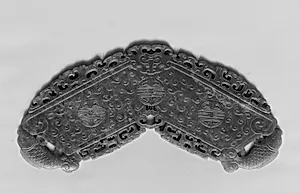
Medium
Nephrite, olive-brown
Dimensions
H. 4 3/16 in. (10.7 cm); W. 8 13/16 in. (22.4 cm); D. 1/4 in. (0.7 cm)
Classification
Jade
Culture & Period
China · Qing dynasty (1644–1911), Qianlong period (1736–95)
Department
Asian Art
Museum
Metropolitan Museum of Art, New York, NY
Credit
Gift of Heber R. Bishop, 1902
Accession Number
02.18.646
Rights
Public Domain
Tags
Art Historical Context
This exquisite *Musical Stone* from China's Qing dynasty, specifically the Qianlong period (6–95), exemplifies the imperial era's mastery of jade carving. Crafted from olive-brown nephrite—a durable yet finely workable form of jade highly prized in Chinese culture—this thin slab measures just 4 3/16 inches high, 13/16 inches, and a remarkable 1/4 inch thick. Its delicate dimensions highlight the artisan's skill in shaping nephrite into a functional yet decorative object, likely struck to produce resonant tones as a lithophone, an ancient musical instrument. Jade held profound cultural significance in China, symbolizing purity, immortality, and imperial virtue. During the Qianlong emperor's reign, a golden age of artistic patronage, jade workshops flourished, producing ritual, ornamental, and scholarly items. The stone's fish motifs, evoking abundance and harmony in Confucian ideals, blend musical utility with symbolic artistry. Though the artist remains unknown, such pieces were often imperial commissions, reflecting elite tastes. Today, this treasure resides in the Metropolitan Museum of Art's Asian Art Department, a 1902 gift from Heber R. Bishop. Visitors can marvel at how its subtle sheen and precise form capture the Qing court's reverence for nature's gifts transformed by human ingenuity.