
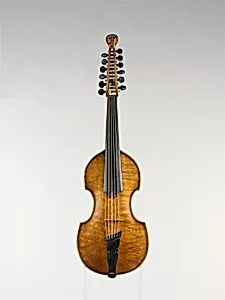
Mute Viola d'Amore
mid-18th century
Medium
Wood
Dimensions
25 1/8 × 7 1/4 × 2 in. (63.8 × 18.4 × 5.1 cm)
Classification
Chordophone-Lute-bowed
Culture
Austrian
Department
Musical Instruments
Museum
Metropolitan Museum of Art, New York, NY
Credit
Purchase, Frederick M. Lehman Bequest, 2007
Accession Number
2007.229
Rights
Public Domain
Art Historical Context
Nestled in the Metropolitan Museum of Art's Musical Instruments collection, the *Mute Viola d'Amore* crafted by Daniel Achatius Stadmann exemplifies mid-18th-century lutherie. Made entirely of wood and measuring 25 1/8 × 7 1/4 × 2 inches, this chordophone—classified as a lute-bowed instrument—features the distinctive design of the viola d, a "love viola" prized for its ethereal, resonant tone. Stadlmann, a renowned Viennese maker active during the Baroque-Rococo transition, shaped its body with elegant curves and precise joinery, highlighting the era's mastery of woodworking techniques. The viola d'amore's "mute" quality arises from its unique construction, including gut strings and often sympathetic resonating strings beneath, which produce a soft, silvery timbre ideal for intimate chamber music. Popular in 17th- and 18th-century Europe, it appeared in works by composers like Heinrich Biber and Antonio Vivaldi, evoking romantic or melancholic moods. This instrument reflects Vienna's vibrant musical culture under Habsburg patronage, where craftsmanship blended functionality with ornamental finesse. Acquired through the Frederick M. Lehman Bequest in 2007, Stadlmann's creation offers visitors a tangible link to the golden age of stringed instruments, inviting reflection on how soundscapes shaped artistic expression.