
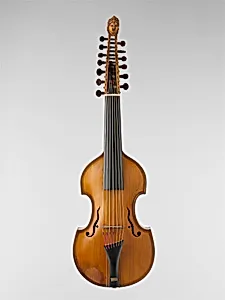
Viola d'Amore
second half 18th century
Medium
Wood
Dimensions
Body L. 41 cm (16.14 in.); Total L. 76.5 cm (30.12 in.); Bowed String L. 36.7 cm (34.39 in.)
Classification
Chordophone-Lute-bowed-unfretted
Culture
French
Department
Musical Instruments
Museum
Metropolitan Museum of Art, New York, NY
Credit
Purchase, Roth Family Gift, in memory of Norman H. Roth, 1986
Accession Number
1986.118.2
Rights
Public Domain
Art Historical Context
Nestled in the Metropolitan Museum Art's collection of musical instruments, the *Viola d'Amore* crafted by Jean-Nicolas Lambert exemplifies the exquisite lutherie of late 18th-century France. Made entirely of wood, this bowed chordophone—classified as a lute-type unfretted instrument—measures 76.5 cm in total length, with a of 41 cm and a bowed string length of .7 cm. Lambert, a skilled Parisian maker, produced this piece during a golden age of string instrument design, when refinements in form and acoustics elevated music-making to an art form. The viola d'amore, beloved by composers like Vivaldi and Marais, stands out for its dual sets of strings: those bowed by the player and sympathetic strings that vibrate in harmony, creating a shimmering, ethereal tone. This French example reflects the Rococo era's elegance, with its graceful curves and varnished wood showcasing masterful joinery and tonal precision. Acquired in 1986 through the Roth Family Gift, it honors the legacy of Norman H. Roth and invites visitors to imagine intimate chamber concerts in Versailles salons. Today, such instruments reveal how craftsmanship intertwined with cultural life, bridging art and sound in Europe's Enlightenment courts.