
Nabby's Point
ca. 1913
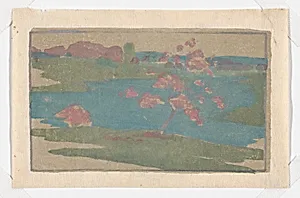
Medium
Color woodcut on cream paper
Dimensions
Image: 2 5/16 × 3 7/8 in. (5.9 × 9.8 cm) Sheet: 2 13/16 × 4 7/16 in. (7.1 × 11.3 cm)
Classification
Woodcut, print
Culture
American
Department
The American Wing
Museum
Metropolitan Museum of Art, New York, NY
Credit
Gift of the Dowd-Gallogly Family and Allan E. Dowd, 2016
Accession Number
2016.406.2
Rights
Public Domain
Tags
Art Historical Context
Nestled in the serene landscapes of early 20th-century America, *Nabby's Point* (ca. 1913) is a delicate color woodcut by Arthur Dow, a pioneering artist and educator whose work bridged Eastern and Western traditions. Dow, for introducing Japanese printmaking techniques to American artists like Georgia O'Keeffe Max Weber, crafted this intimate scene on cream paper, measuring just 2 5/16 × 3 7/8 inches. The medium's small scale invites close contemplation, evoking the precision of ukiyo-e woodblocks while capturing New England's tranquil hills, lakes, and trees—likely inspired by Dow's beloved Ipswich, Massachusetts environs. Dow's innovative approach to color woodcuts involved carving multiple blocks for layered pigments, achieving harmonious compositions that emphasized rhythm and notan (light-dark patterns). This print exemplifies his philosophy from his influential book *Composition* (1899), prioritizing abstract beauty over mere representation. As part of The Metropolitan Museum of Art's American Wing, gifted in 2016, *Nabby's Point* highlights Dow's role in elevating printmaking as fine art, offering visitors a window into America's artistic awakening to global influences during the Progressive Era. Gaze closely to appreciate the subtle interplay of natural forms in this pocket-sized masterpiece.
About the Artist
Arthur Wesley Dow · 1857–1922
Arthur Wesley Dow (1857–1922) was an American artist, printmaker, and educator whose ideas about composition and design exerted an outsized influence on American modernism, reaching well beyond anything his own paintings and prints might have achieved on their own. Born in Ipswich, Massachusetts, he studied in Boston and then in Paris at the Académie Julian, where he absorbed the academic training...