
Nabby's Point
ca. 1913
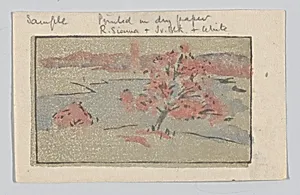
Medium
Color woodcut; trial proof on cream paper
Dimensions
Image: 2 5/16 × 3 7/8 in. (5.9 × 9.8 cm) Sheet: 2 15/16 × 4 13/16 in. (7.5 × 12.2 cm)
Classification
Woodcut, print
Culture
American
Department
The American Wing
Museum
Metropolitan Museum of Art, New York, NY
Credit
Gift of the Dowd-Gallogly Family and Allan E. Dowd, 2016
Accession Number
2016.406.4
Rights
Public Domain
Tags
Art Historical Context
**Nabby's Point** by Arthur Wesley Dow (1857–1922), created around 1913, invites visitors into a serene, intimate landscape captured in a rare color woodcut trial proof cream paper. Measuring just over 2 by 4 inches, this delicate print evokes the quiet beauty of trees at Nabby's Point, likely a coastal New England vista familiar to the artist from his Ipswich, Massachusetts roots. As part of The American Wing at The Metropolitan Museum of Art—gifted by the Dowd-Gallogly Family and Allan E. Dowd in 2016—it exemplifies early 20th-century American printmaking. Dow, a pioneering educator at Pratt Institute and Columbia University, revolutionized American art by championing Japanese ukiyo-e techniques. His color woodcuts, like this one, layered translucent inks through meticulous carving and printing, blending Eastern precision with Western naturalism. This trial proof reveals Dow's experimental process—testing colors and compositions before final editions—highlighting his role in bridging Arts and Crafts ideals with modernism. Through its modest scale and subtle tones, *Nabby's Point* captures Dow's philosophy of harmony between nature and design, influencing generations including Georgia O'Keeffe. A gem for print enthusiasts, it underscores America's embrace of global artistic traditions during a transformative era.
About the Artist
Arthur Wesley Dow · 1857–1922
Arthur Wesley Dow (1857–1922) was an American artist, printmaker, and educator whose ideas about composition and design exerted an outsized influence on American modernism, reaching well beyond anything his own paintings and prints might have achieved on their own. Born in Ipswich, Massachusetts, he studied in Boston and then in Paris at the Académie Julian, where he absorbed the academic training...