
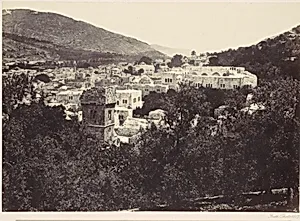
Nablous, The Ancient Shechem
1857
Medium
Albumen silver print from glass negative
Classification
Photographs
Department
Photographs
Museum
Metropolitan Museum of Art, New York, NY
Credit
David Hunter McAlpin Fund, 1966
Accession Number
66.640.1.28
Rights
Public Domain
Tags
Art Historical Context
Step into the sun-drenched hills of 19th-century Palestine with Frith's *Nablous, The Ancientchem* (1857), an albumen silver print that captures the timeless allure of this biblical cityscape. Frith, a pioneering British, ventured into the Middle East during the 1850s, ancient sites like Shechem—modern-day Nablus in the West Bank—with remarkable clarity. Nestled amid rugged mountains, the image reveals a blend of Ottoman-era architecture, bustling city life, and the enduring presence of sacred history, evoking the Holy Land's spiritual resonance for Victorian-era viewers hungry for exotic vistas. This photograph exemplifies early photographic innovation: printed from a glass negative using the albumen process, where paper was sensitized with egg whites and silver salts for deep, luminous tones and fine detail. Popular from the 1850s onward, albumen prints allowed Frith to produce durable, richly toned images that rivaled paintings in their topographical precision, making distant landscapes accessible to museums and collectors. Housed in The Metropolitan Museum of Art's Photographs Department (David Hunter McAlpin Fund, 1966), *Nablous* highlights Frith's role in shaping Western perceptions of the Orient, bridging archaeology, travel, and emerging visual culture. A window to a vanished era, it invites us to ponder the mountains' ancient whispers.
About the Artist
Francis Frith · 1822–1898
Francis Frith (1822–1898) was born on 7 October 1822 in Chesterfield, Derbyshire, into a prosperous Quaker merchant family as the second child and only son of Francis Frith Sr. and Alice Walker. Educated at Quaker schools including Ackworth and Camp Hill in Birmingham from around 1828 to 1838, he apprenticed in the cutlery trade before establishing himself as a wholesale grocer in Liverpool, suppl...