
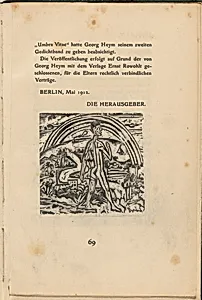
Nachtwort (Night Word) (in-text plate) from mock-up of Georg Heym: Umbra Vitae (Georg Heym: Shadow of Life)
1912/1922
Medium
woodcut from a bound volume with 51 woodcuts (including cover and front and back endpapers) on wove paper
Dimensions
book: 21.7 × 14.5 × 1.3 cm (8 9/16 × 5 11/16 × 1/2 in.)
Classification
Volume
Department
CG-W
Museum
National Gallery of Art, Washington, D.C.
Credit
Gift of Ruth Cole Kainen
Accession Number
2012.92.40.49
Rights
Public Domain
Art Historical Context
**Nachtwort (Night Word)**, a striking woodcut by Ernst Ludwig, serves as an in-text plate in 1912/1922 mock-up of *Georg Heym: Um Vitae* (*Shadow of Life*), a volume featuring 51 woodcuts on wove paper. Kirchner, a founding member of the revolutionary Die Brücke group, channeled the raw energy of German Expressionism into this project, illustrating the haunting poems of Georg Heym, an early modernist poet who tragically died young in 1912. Created amid the turbulence of pre-World War I Europe, the book captures the era's fascination with urban alienation, mortality, and inner turmoil—themes central to both Heym's "shadow of life" and Kirchner's visceral style. Kirchner's mastery of woodcut shines here, a medium he championed for its primal, direct carving that yields bold contrasts and jagged lines, evoking emotional intensity over realism. This mock-up, measuring 21.7 × 14.5 × 1.3 cm, represents an experimental precursor to the final publication, showcasing his innovative integration of text and image in a compact, tactile format. Housed in the National Gallery of Art as a gift from Ruth Cole Kainen (Department CG-W), it highlights Kirchner's pivotal role in elevating printmaking to fine art. Visitors will appreciate how *Nachtwort* distills Expressionism's psychological depth into a single, potent image, bridging poetry and visual power in a way that still resonates today.
About the Artist
Ernst Ludwig Kirchner · 1880–1938
Ernst Ludwig Kirchner was born on May 6, 1880, in Aschaffenburg, Germany, to parents Ernst and Maria Kirchner, part of a family of Prussian descent that frequently relocated due to his father's career as a chemical technician. After early schooling in various towns, he studied architecture at the Königliche Technische Hochschule (Technical University) in Dresden from 1901 to 1905, taking courses i...