
Nada (Nothing)
1810/1820
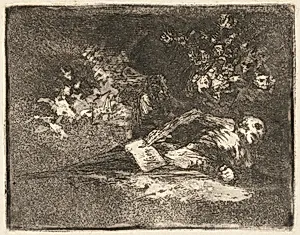
Medium
etching, aquatint and lavis with burnishing (proof) on laid paper
Dimensions
sheet: 22.2 × 32.1 cm (8 3/4 × 12 5/8 in.) plate: 15.3 × 19.5 cm (6 × 7 11/16 in.)
Classification
Department
CG-E
Museum
National Gallery of Art, Washington, D.C.
Credit
Rosenwald Collection
Accession Number
1943.3.4718
Rights
Public Domain
Art Historical Context
Francisco Goya's *Nada (Nothing)*, created between 1810 and 1820, is a poignant print from the Spanish master's late career, a period marked by the turmoil of the Peninsular War and Spain's Napoleonic occupation. As a leading figure in Romanticism, Goya shifted from court portraiture to raw, unflinching depictions of human suffering, blending satire with profound humanism. This work exemplifies his innovative printmaking, using etching for precise lines, aquatint moody tonal depths, lavis for subtle wash effects, and burnishing to soften highlights—techniques that allowed extraordinary expressiveness on a modest plate size of 15.3 × 19.5 cm. Printed as a proof on laid paper, *Nada* captures Goya's mastery of mixed media, where trial impressions like this reveal his experimental process, refining shadows and textures before final editions. Housed in the National Gallery of Art's Rosenwald Collection, it reflects the era's cultural upheaval, inviting viewers to ponder themes of futility and loss amid war's devastation. Though compact, its intimate scale draws us into Goya's unflagging critique of violence, making it a timeless emblem of resilience in art.
About the Artist
Francisco Goya · 1746–1828
Francisco Goya, born on March 30, 1746, in the small Aragonese village of Fuendetodos, Spain, to a gilder father and a mother from a family claiming minor nobility, displayed artistic promise early. At age 14, he apprenticed under painter José Luzán y Martínez in Zaragoza, honing his skills by copying prints before working independently. After unsuccessful attempts to enter Madrid's Real Academia ...