
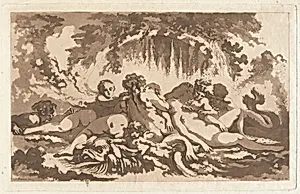
Naiads and Tritons
Medium
etching and aquatint printed in brown on laid paper
Dimensions
plate: 23.7 × 37.4 cm (9 5/16 × 14 3/4 in.) sheet: 31.3 × 44 cm (12 5/16 × 17 5/16 in.)
Classification
Department
CG-E
Museum
National Gallery of Art, Washington, D.C.
Credit
Pepita Milmore Memorial Fund
Accession Number
2018.91.52
Rights
Public Domain
Art Historical Context
Created in 1766 by Jean-Claude-Richard, Abbé de Saint-Non, *Naiads and Trit* captures the playful world classical mythology. The scene brings together sea nymph and mermen in a lively marine composition, reflecting the eighteenth-century fascination with ancient themes reinterpreted through a light, decorative lens. As an amateur artist and prominent collector, Saint-Non often explored such subjects in his prints, bridging his interests in art, travel, and classical antiquity. The work’s medium—an etching and aquatint printed in brown ink on laid paper—demonstrates the period’s growing interest in tonal printmaking. Aquatint allowed artists to achieve soft, wash-like effects that mimic drawings or paintings, giving the composition a fluid, atmospheric quality rather than the sharp lines typical of traditional etching. This technique helped convey the watery, luminous world of the mythological figures with subtle gradations of tone. Measuring roughly 24 by 37 centimeters in the plate, the print exemplifies the refined reproductive and original print culture of Enlightenment France. Its delicate execution and mythological subject matter would have appealed to educated viewers who valued both classical learning and the latest artistic innovations.