
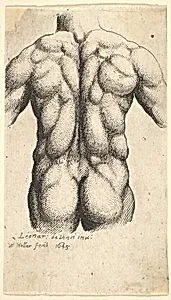
Naked male torso seen from behind
Medium
Etching; only state
Dimensions
3 9/16 x 2 1/16 in. (9.1 x 5.2 cm) upper left and bottom right corners cut
Classification
Prints
Department
Drawings and Prints
Museum
Metropolitan Museum of Art, New York, NY
Credit
Purchase, Joseph Pulitzer Bequest, 1917
Accession Number
17.50.18-239
Rights
Public Domain
Tags
Art Historical Context
This delicate etching, titled *Naked Male Torso Seen from Behind*, captures the masterful anatomy of a male nude in a rear view, attributed to Leonardo da Vinci as the original draftsman andenceslaus Hollar as theaver. Created in 1645—the only known state of this print—its modest dimensions (3 9/16 x 2 1/16 in.) reflect the intimate scale of Renaissance drawing studies, though the upper left and bottom right corners have been trimmed, adding a touch of historical wear. Hollar, a prolific 17th-century Bohemiancher based in London, faithfully reproduced Leonardo's intricate pen-and-ink drawing, likely from the master's renowned anatomical sketches preserved in collections like the Royal Collection. Leonardo, the quintessential Renaissance polymath, dissected cadavers to understand the human form, revolutionizing artistic representation with unprecedented realism and three-dimensionality. This work exemplifies his obsession with musculature and proportion, echoing classical ideals while advancing empirical observation. Housed in the Metropolitan Museum of Art's Drawings and Prints department (acquired via the Joseph Pulitzer Bequest in 1917), the etching bridges Renaissance innovation and Baroque dissemination. It invites visitors to appreciate how prints like this preserved Leonardo's genius for generations, making elite studies accessible and underscoring the enduring cultural reverence for the male nude as a pinnacle of artistic exploration.
About the Artist
Leonardo da Vinci|Wenceslaus Hollar · 1452–1519
Leonardo da Vinci (1452-1519) stands as the quintessential Renaissance polymath, whose genius spanned painting, sculpture, architecture, science, mathematics, engineering, anatomy, geology, cartography, botany, and writing. Born in Vinci, Italy, as the illegitimate son of a notary, Leonardo received limited formal education but demonstrated extraordinary artistic talent from an early age. His appr...