
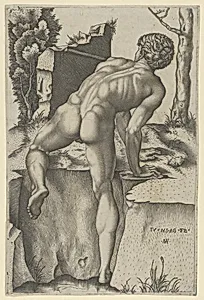
Naked man viewed from behind climbing a river bank, after Michelangelo
Medium
Engraving
Dimensions
Sheet: 8 1/4 × 5 3/8 in. (20.9 × 13.7 cm)
Classification
Prints
Department
Drawings and Prints
Museum
Metropolitan Museum of Art, New York, NY
Credit
Anonymous Gift, 1929
Accession Number
29.44.5
Rights
Public Domain
Tags
Art Historical Context
Behold the dynamic *Naked Man Viewed from Behind Climbing a River Bank an engraving by Marcantonio Raimondi after a design by Michelangelo Buonarroti circa 1509. intimate print captures a muscular male figure mid-stride, scrambling up a steep, watery embankment, his back turned to us in a pose brimming with tension and vitality. Measuring just 8¼ × 5⅜ inches, it exemplifies the precision of Renaissance engraving, a technique where intricate lines are incised into a copper plate to produce richly detailed impressions on paper. Created during Michelangelo's High Renaissance peak—amid masterpieces like the Sistine Chapel ceiling— this work reflects the artist's profound study of human anatomy. Raimondi, a masterful Italian engraver, faithfully reproduced Michelangelo's drawing, making the master's genius accessible beyond elite patrons through affordable prints. Such reproductive engravings revolutionized art dissemination, allowing collectors across Europe to own echoes of Italian innovation. As a prime example of the male nude tradition, it highlights Renaissance reverence for the idealized body, drawn from classical antiquity and live models. Housed in the Metropolitan Museum of Art's Drawings and Prints department (Anonymous Gift, 1929), this piece invites us to marvel at the enduring power of the human form in art.
About the Artist
Marcantonio Raimondi|Michelangelo Buonarroti · 1475–1534
Marcantonio Raimondi (c. 1480–1534), born near Bologna, Italy, emerged as one of the Renaissance's premier engravers, revolutionizing printmaking through his mastery of reproductive techniques. He trained in the workshop of the goldsmith, painter, and niellist Francesco Francia, whose influence is evident in his early engravings, such as the goldsmith-like shading in *Pyramus and Thisbe* (1505), h...