
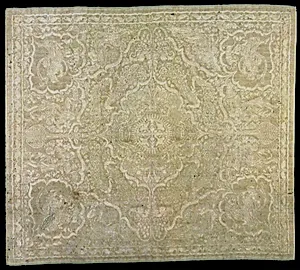
Napkin Depicting The Five Senses
1891
Medium
Linen, satin weave self-patterned by reversing of faces
Dimensions
67.7 × 76.8 cm (26 5/8 × 30 1/4 in.)
Classification
textile
Department
Textiles
Museum
Art Institute of Chicago
Accession Number
74703
Rights
Public Domain
Art Historical Context
Created in 1891 by Walter Crane, a leading figure in Britain’s Arts and Crafts movement, this linen napkin transforms a humble household object into a work of symbolic art. Crane, celebrated for his illustrations and decorative designs, often drew on medieval and Renaissance traditions while championing handcrafted beauty against the rise of industrial mass production. The piece employs a satin-weave damask technique, in which the pattern emerges solely from the reversal of the fabric’s faces, creating a subtle play of light and texture without added color or embroidery. The central theme depicts the Five Senses, a subject with deep roots in European allegory. Rendered in crisp, linear motifs characteristic of Crane’s graphic style, the senses appear as graceful figures engaged with flowers, musical instruments, and other evocative objects. Measuring roughly 27 by 30 inches, the napkin would have graced an elegantly set table, reminding diners of the pleasures of perception while demonstrating how fine design could elevate daily life. Today it resides in the Art Institute of Chicago’s textile collection, a quiet testament to Crane’s belief that art belongs in the home as much as on gallery walls.
About the Artist
Walter Crane · 1845–1915
British artist, illustrator, and designer.