
Narcissus
1851 to 1875
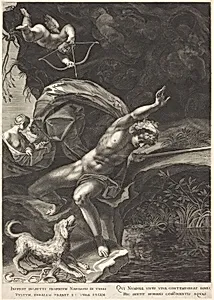
Medium
etching with engraving on laid paper
Dimensions
sheet: 40.8 x 28.2 cm (16 1/16 x 11 1/8 in.) (cut to platemark)
Classification
Department
CG-E
Museum
National Gallery of Art, Washington, D.C.
Credit
Ailsa Mellon Bruce Fund
Accession Number
2010.87.4
Rights
Public Domain
Art Historical Context
Behold the captivating print *Narcissus* by Aegidius Sadeler, a Flemish master engraver of the late Renaissance. Created as an etching with engraving on laid paper, this 19th-century impression (dated 1851–1875) measures 40.8 × 28.2 cm and captures the platemark. The work depicts the ancient Greek myth of Narcissus the youth entranced by his own reflection a pool, symbolizing themes of vanity, self-love, and tragic beauty that have inspired artists for centuries. Sadeler II, part of a renowned family of printmakers, excelled in reproductive techniques, translating paintings into intricate prints. Here, etching provides fluid, spontaneous lines, while engraving adds precise, tonal depth, showcasing the medium's versatility on laid paper—a traditional support with visible chain lines that nods to early printmaking heritage. This combination allowed for rich contrasts and subtle shading, evoking the dramatic Mannerist style prevalent in Northern Europe. Housed in the National Gallery of Art's Prints department (CG-E) through the Ailsa Mellon Bruce Fund, *Narcissus* highlights the enduring legacy of printmaking as an accessible art form. It invites visitors to ponder the mirror of self-reflection, bridging classical mythology with technical innovation in a piece that's both historically significant and visually mesmerizing.
About the Artist
Aegidius Sadeler II · 1568–1629
Netherlandish, Antwerp 1568–1629 Prague