
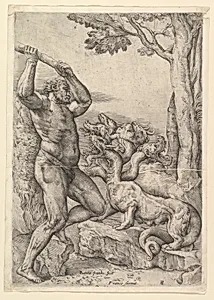
Hercules Killing the Hydra of Lerna
after 1552
Medium
Etching and engraving; second state
Dimensions
sheet: 12 1/2 x 8 7/8 in. (31.8 x 22.6 cm) plate: 12 3/16 x 8 1/4 in. (31 x 21 cm)
Classification
Prints
Department
Drawings and Prints
Museum
Metropolitan Museum of Art, New York, NY
Credit
Harris Brisbane Dick Fund, 1926
Accession Number
26.70.3(226)
Rights
Public Domain
Tags
Art Historical Context
Behold *Hercules Killing the of Lerna*, a dynamic etching and engraving by the Venetian artist Battista Franco, created after 1552. This second-state impression captures one of the hero's legendary Twelve Labors from Greek mythology: Hercules' fierce battle against the multi-headed serpent Hydra in the swamps of Lerna. Franco, a Mannerist master active in Venice and Rome, drew inspiration from classical antiquity, blending muscular figures with dramatic tension in a style echoing Michelangelo's influence. Printed on a modest sheet of 12½ × 8⅞ inches, the work exemplifies 16th-century printmaking techniques. Etching allowed Franco's fluid, expressive lines to convey motion and fury, while engraving added precise details to the hero's straining form and the beast's writhing heads. As a print, it democratized access to grand mythological narratives, popular among Renaissance collectors eager to revive ancient tales amid the era's humanist fervor. Housed in the Metropolitan Museum of Art's Drawings and Prints department (acquired via the Harris Brisbane Dick Fund in 1926), this piece highlights Hercules as a symbol of triumph over chaos—resonating in art as a metaphor for human resilience. A captivating glimpse into Mannerist print culture!
About the Artist
Battista Franco · 1510–1561
Battista Franco, known as il Semolei, was born in Venice around 1510, though his career unfolded largely in Rome and at the courts of central and northern Italy. He came to Rome in his twenties and immediately fell under two powerful spells: the inexhaustible riches of classical antiquity and the overwhelming presence of Michelangelo. Franco spent years making drawings after ancient sculptures and...