
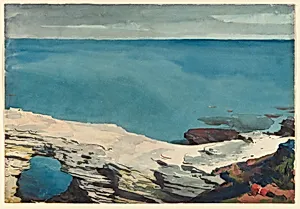
Natural Bridge, Bermuda
ca. 1901
Medium
Watercolor and graphite on white wove paper
Dimensions
14 7/16 x 21 in. (36.7 x 53.3 cm)
Classification
Watercolor
Culture
American
Department
The American Wing
Museum
Metropolitan Museum of Art, New York, NY
Credit
Amelia B. Lazarus Fund, 1910
Accession Number
10.228.12
Rights
Public Domain
Tags
Art Historical Context
Winslow Homer, one of America’s most celebrated 19th-century artists, created *Natural Bridge Bermuda* around 1901 during one of his winter visits to the island. By this time, Homer had turned increasingly to watercolor, using the medium to explore the raw power and luminous beauty of the sea. The painting depicts Bermuda’s famous rock arch, a dramatic natural formation that frames the ocean beyond, reflecting his lifelong fascination with coastal scenes and the forces of nature. Executed in watercolor and graphite on paper, the work reveals Homer’s technical mastery. He layered translucent washes to suggest the movement of water and the play of tropical light across the stone, while delicate graphite lines anchor the composition. This approach allowed him to balance precision with spontaneity, capturing both the solidity of the bridge and the ever-changing sea. Acquired by the Metropolitan Museum in 1910 through the Amelia B. Lazarus Fund, the piece now resides in the American Wing. It stands as a fine example of Homer’s late watercolors, which helped elevate the medium’s status in American art and continue to inspire viewers with their quiet drama and technical brilliance.
About the Artist
Winslow Homer · 1836–1910
Winslow Homer (1836-1910) was one of America's greatest painters and a preeminent figure in 19th-century American art. Largely self-taught, Homer began his career as a commercial illustrator and Civil War correspondent for Harper's Weekly before becoming renowned for his powerful marine subjects and landscape paintings. His mastery of both oil and watercolor, combined with his uncompromising reali...