
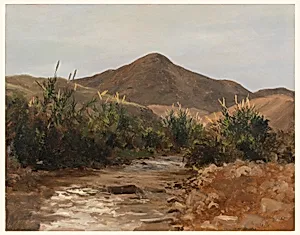
Near Jericho, Wady Kilt
March 20, 1876
Classification
landscapes
Department
Smithsonian Collection
Museum
Smithsonian American Art Museum
Credit
Gifted by a Private Santa Barbara Collector, courtesy of Sullivan Goss - An American Art Gallery
Accession Number
2013-38-1
Rights
Public Domain
About this artwork
A stream in foreground, boarded on edges with scrub grass, leads toward distant mountain in the center rear.
Art Historical Context
Lockwood de Forest’s “Near Jericho, Wady Kilt,” painted on March 20, 1876, captures a tranquil Middle Eastern landscape during a time when many American artists traveled to the Holy Land seeking inspiration from biblical sites. De Forest, who trained under luminist master Frederic Edwin Church, brought a keen eye for light and atmosphere to this on-site study. The work depicts a gentle stream edged with scrub grass that draws the viewer’s gaze toward a distant mountain, evoking the timeless terrain near ancient Jericho. As part of the Smithsonian American Art Museum’s collection, the painting reflects the 19th-century fascination with exotic and sacred landscapes. De Forest’s precise dating suggests he worked directly from nature, recording the subtle play of light across arid hills and water. Though the medium remains unidentified, the composition’s calm recession and naturalistic detail align with the Hudson River School tradition adapted to foreign settings. This gifted work offers visitors a quiet window into both the geography of the region and the exploratory spirit of American landscape painting in the post-Civil War era.