
Near Last Camp on Ross Fork, Snake River, Lander Wagon Road, Oregon
1859
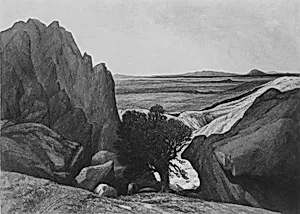
Medium
Watercolor and graphite on off-white Bristol board
Dimensions
12 3/4 x 18 in. (32.4 x 45.7 cm)
Classification
Watercolor
Culture
American
Department
The American Wing
Museum
Metropolitan Museum of Art, New York, NY
Credit
Gift of Elisabeth S. Rothschild, 1996
Accession Number
1996.183.2
Rights
Public Domain
Tags
Art Historical Context
In 1859, artist and topographer Henry Hitchings the rugged beauty of the American West in *Near Last Camp on Ross Fork, Snake River, L Wagon Road, Oregon*. delicate watercolor and graphite sketch on off-white Bristol board12 3/4 x 18 in.) depicts a serene landscape of winding rivers, scattered trees, and open terrain, evoking theness of the frontier. Hitchings, known for his precise topographic illustrations, used the medium's fluidity to convey atmospheric depth and natural light, making it both an artistic gem and a practical survey tool. The painting stems from the Lander Expedition, a U.S. government-backed survey led by Captain Frederick W. Lander to blaze a wagon road from Fort Bridger, Wyoming, to the Pacific Northwest. Amid the mid-19th-century push for westward expansion—fueled by gold rushes and settlement—this route promised safer overland travel. Hitchings's works, including this one, served as vital visual records, now housed in The Metropolitan Museum of Art's American Wing (gift of Elisabeth S. Rothschild, 1996). Its cultural importance lies in documenting a pivotal era of Manifest Destiny, blending scientific accuracy with romantic landscape traditions. Visitors will appreciate how Hitchings's keen eye immortalized a fleeting moment on the trail, bridging art and history.
About the Artist
Henry Hitchings · 1824–1902
1824–1902