
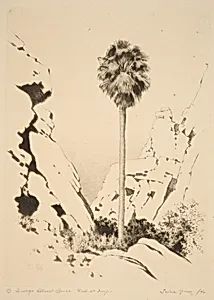
Palm Canyon (no.1)
c. 1920
Medium
drypoint in black on wove paper
Dimensions
plate: 17.2 x 12.5 cm (6 3/4 x 4 15/16 in.) sheet: 25.2 x 20.2 cm (9 15/16 x 7 15/16 in.)
Classification
Department
CG-W
Museum
National Gallery of Art, Washington, D.C.
Credit
Gift of Mrs. John Farr Simmons
Accession Number
1986.60.5
Rights
Public Domain
Art Historical Context
**Palm Canyon (No.1)**, created around 1920 by American printmaker George Elbert Burr, the stark beauty of the American Southwest a masterful drypoint etching. Burr (1859–1939), renowned for his luminous landscapes of deserts and canyons, drew inspiration from his time in California and Arizona, where he settled to portray the region's dramatic natural forms. This intimate plate (17.2 x 12.5 cm) on wove paper evokes the depths and sunlit palms of a canyon, likely referencing iconic sites like those in Palm Springs or Arizona's rugged terrain. Drypoint, Burr's favored technique, involves scratching directly into a metal plate with a sharp needle, raising a soft "burr" that holds ink for richly textured, velvety lines. Unlike the precise lines of traditional etching, drypoint allows for spontaneous, atmospheric effects—perfect for conveying the play of light on rocky cliffs and sparse vegetation. This print exemplifies the early 20th-century etching revival, when artists celebrated America's wilderness amid rapid urbanization. A generous gift to the National Gallery of Art from Mrs. John Farr Simmons, *Palm Canyon (No. 1)* invites visitors to savor the quiet grandeur of the West, bridging art and nature in a timeless dialogue. (198 words)
About the Artist
George Elbert Burr · 1859–1939
George Elbert Burr was an American printmaker and watercolorist whose career spanned the late nineteenth and early twentieth centuries, earning him a reputation as one of the foremost etchers of the American West. Born in 1859 in Monroe Falls, Ohio, Burr trained as a commercial illustrator before turning his full attention to fine art. He honed his craft through diligent self-study and close obser...