
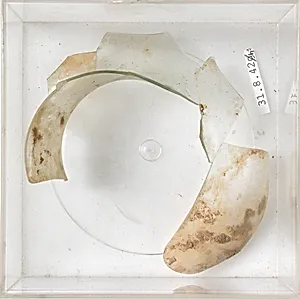
Neck of a Vessel
Unknown Artist
4th century
Medium
Glass
Dimensions
Storage (dim. of box): 3 15/16 x 3 15/16 in. (10 x 10 cm)
Classification
Glass-Vessels
Culture
Coptic
Department
Medieval Art
Museum
Metropolitan Museum of Art, New York, NY
Credit
Rogers Fund, 1931
Accession Number
31.8.42.27
Rights
Public Domain
Art Historical Context
This delicate fragment, known as the *Neck of a Vessel hails from 4th-century Coptic Egypt, a vibrant era when Christianity was taking root amid ancient pharaonic traditions. Crafted by an unknown artisan, this glass piece—preserved in the Metropolitan Museum Art's Medieval Art collectionoffers a glimpse into everyday life in early Christian communities along the Nile. Acquired through the Rogers Fund in 1, it exemplifies the Coptic culture's fusion of Roman techniques and local ingenuity. Glassmaking flourished in Egypt from pharaonic times, reaching new heights with the Roman innovation of glassblowing around the 1st century BCE. By the 4th century, Coptic workshops produced vessels like this one for practical uses such as storing oils, perfumes, or wine, sometimes with ritual significance in Christian liturgy. The slender neck suggests a blown-glass form, showcasing the precision required to create thin, translucent walls that caught the light. Though only a fragment, this artifact underscores the continuity of Egyptian craftsmanship into the medieval period. Its survival highlights how humble objects illuminate the daily world of Coptic Christians, bridging pagan pasts and emerging faiths in a culturally rich crossroads of Africa, Europe, and the Near East.