
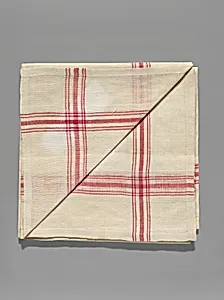
Neckerchief
Medium
Cotton, woven
Dimensions
32 1/4 x 32 1/4 in. (81.9 x 81.9 cm)
Classification
Neckerchief
Culture
American, Shaker
Department
The American Wing
Museum
Metropolitan Museum of Art, New York, NY
Credit
Gift of Mrs. G. James Fawcett, in memory of John S. Rudd, 1985
Accession Number
1985.40.5
Rights
Public Domain
Art Historical Context
Step into the world of the Shakers with this exquisite *Neckerchief*, crafted around 1868 by members of the United Society ofievers in Christ’s Secondaring, a devout American religious community founded in the 18th. Measuring a perfect square at 32¼ x 32¼ inches, this woven cotton piece was designed for practical use—draped around the neck warmth or modesty—reflecting the Shakers' commitment to simplicity and utility in everyday life. Now housed in The Metropolitan Museum of Art's American Wing, it stands as a testament to their self-sufficient communities in places like New Lebanon, New York. The Shakers, often called "Shaking Quakers" for their ecstatic worship, elevated craftsmanship to an act of devotion, guided by the motto "Hands to work, hearts to God." Their textiles, like this one, embodied their aesthetic of unadorned perfection: plain weaves in fine cotton produced on communal looms, prioritizing durability, even dye distribution, and flawless execution over decoration. Women, who played central roles in Shaker industries, likely wove this neckerchief, showcasing their skill in creating functional beauty amid a celibate, egalitarian society that peaked in the mid-19th century. Though modest in appearance, the neckerchief reveals the Shakers' profound cultural influence on American design, inspiring modern minimalism from architects like Frank Lloyd Wright. Its gift to the Met in 1985 honors this legacy, inviting us to appreciate how faith wove simplicity into art.