
Necklace
Unknown Artist
12th–13th century
Medium
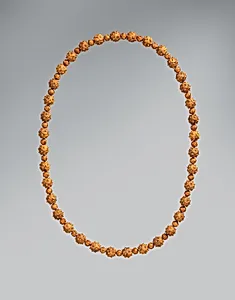
Gold (sheet); granulation and twisted wire
Dimensions
Ht. 11 7/16 in. (29 cm) W. 5 1/2 in. (14 cm) Diam. 9 7/16 in. (24 cm) D. 9/16 in. (1.5 cm) Wt. 3.499 oz (99.2g) small beads: 1/16 in. (0.1 cm) large beads: 9/16 in. (1.5 cm)
Classification
Jewelry
Department
Islamic Art
Museum
Metropolitan Museum of Art, New York, NY
Credit
Purchase, Hess Foundation Gift, 1972
Accession Number
1972.188.1
Rights
Public Domain
Tags
Art Historical Context
This exquisite gold necklace, dating to the 12th–13th century, hails from the Islamic world and exemplifies the pinnacle of medieval jewelry craftsmanship. Housed in the Metropolitan Museum Art's Department of Islamic Art, it was acquired through the Hess Foundation Gift in1972. Measuring an impressive 11 716 inches (29 cm in height and weighing nearly 3.5 ounces (99.2 g), this substantial piece would have draped elegantly around the neck, signaling wealth and high social status for its wearer—likely an elite woman during a golden age of Islamic artistic production. Crafted from hammered gold sheet, the necklace dazzles with two hallmark techniques: granulation, where minuscule beads (as tiny as 1/16 inch or 0.1 cm) are meticulously fused to the surface without solder, creating a shimmering, textured mosaic; and twisted wire, which adds delicate filigree accents alongside larger beads (up to 9/16 inch or 1.5 cm). These methods highlight the extraordinary technical prowess of Islamic goldsmiths, who mastered fire-gilding and precise heat control long before modern tools. Beyond its beauty, the necklace reflects the cultural centrality of jewelry in Islamic societies, where such adornments featured in weddings, celebrations, and daily displays of piety and prosperity. A true treasure, it invites us to marvel at the enduring allure of ancient ingenuity.