
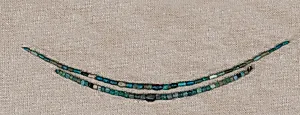
Necklace
Unknown Artist
ca. 1981–1295 B.C.
Medium
Faience
Dimensions
l. 39 cm (15 3/8 in)
Classification
Necklace, beads
Period
Middle Kingdom–Early New Kingdom
Department
Egyptian Art
Museum
Metropolitan Museum of Art, New York, NY
Credit
Rogers Fund, 1915
Accession Number
15.3.454
Rights
Public Domain
Art Historical Context
This exquisite faience necklace, dating from around 1981–1295 B.C. during Egypt's Middle Kingdom to Early New Kingdom (Dynasties 12–18), showcases the ancient Egyptians' mastery of vibrant, affordable jewelry. Crafted from faience—a glazed ceramic composite of quartz, lime, and clay—the piece gleams with the signature turquoise-blue hue that mimicked precious stones like lapis lazuli and turquoise materials reserved for elites. At 39 cm long, it would have draped elegantly around the neck, likely strung with beads or amulets for both men and women. Faience's significance lies in its production technique: artisans molded and fired the frit-like material, then applied a vitreous glaze that fused in the kiln, creating a durable, jewel-like sheen. Such necklaces held profound cultural weight, often serving as protective talismans against evil or symbols of fertility and rebirth, aligned with deities like Hathor or Isis. Worn in daily life or burials, they democratized beauty and spirituality beyond gold. Acquired through the Rogers Fund in 1915, this necklace now graces the Metropolitan Museum of Art's Egyptian Art collection, offering a tangible link to an era of pyramid-building innovation and artistic splendor. Imagine its wearer striding through temple courtyards, a pop of eternal blue amid sun-baked sands!