
Necklace Elements
Unknown Artist
11th–13th century
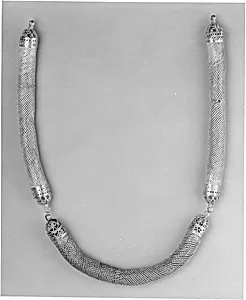
Medium
Gold
Dimensions
1979.72a: L. 3 3/8 in. (8.5 cm) W. 3/8 in. (1 cm) D. 3/8 in. (1 cm) 1979.7.2b:L. 4 5/16 in. (11 cm) W. 3/8 in. (1 cm) D. 3/8 in. (1 cm) 1979.7.2c: L. 3 3/8 in. (8.5 cm) W. 3/8 in. (1 cm) D. 3/8 in. (1 cm)
Classification
Jewelry
Department
Islamic Art
Museum
Metropolitan Museum of Art, New York, NY
Credit
Purchase, Richard S. Perkins Gift, Rogers Fund, Louis E. and Theresa S. Seley Purchase Fund for Islamic Art, and Norbert Schimmel, Jack A. Josephson and Edward Ablat Gifts, 1979
Accession Number
1979.7.2a–c
Rights
Public Domain
Art Historical Context
These exquisite *Necklace Elements*1979.72a–c), crafted from gold in the 11th–13th centuries, offer a glimpse into the refined world of medieval Islamic jewelry. Comprising slender components—measuring approximately 3⅜ to 4¼ inches in length, with consistent narrow widths and depths of ⅜ inch—they likely served as pendants, links, or spacers in a prestigious necklace. Acquired by The Metropolitan Museum of Art in1979 through generous gifts and funds dedicated to Islamic art, these highlight the museum's commitment to preserving such treasures. Dating to a dynamic era spanning the Fatimid, Seljuk, and early Ayyubid periods, gold jewelry like this symbolized wealth, status, and cultural sophistication across the Islamic world, from North Africa to Central Asia. Gold's malleability allowed artisans to create lightweight yet durable ornaments, often worn by women at court or during celebrations. Though the artist's identity remains unknown, the precision of these elements reflects masterful metalworking traditions, where form and portability were paramount. Visitors will appreciate the timeless elegance of these artifacts, evoking the opulence of medieval Islamic courts while inviting reflection on the enduring allure of personal adornment.