
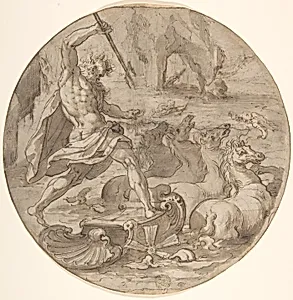
Neptune in his Chariot
late 16th–mid 17th century
Medium
Pen and brown ink, brown wash, over traces of black chalk
Dimensions
Diameter 7-15/16 in. (20.2 cm)
Classification
Drawings
Department
Drawings and Prints
Museum
Metropolitan Museum of Art, New York, NY
Credit
Gift of Cornelius Vanderbilt, 1880
Accession Number
80.3.78
Rights
Public Domain
Tags
Art Historical Context
This delicate circular drawing captures Neptune, the Roman god of the sea, guiding his chariot across the waves, accompanied by powerful horses. Created between the late sixteenth and mid-seventeenth centuries, the work reflects the enduring fascination with classical mythology during the late Renaissance and early Baroque periods. Attributed to Joseph Heintz the Elder and Pieter de Jode I, the piece likely served as a preparatory study or design for a decorative scheme, its compact diameter of just over seven inches suggesting it may have been intended for a medallion, print, or architectural ornament. Executed in pen and brown ink with fluid brown washes over faint black chalk underdrawing, the artwork demonstrates the artists’ mastery of dynamic composition within a confined round format. The layered technique allows for both precise line work and atmospheric shading, lending a sense of movement to the churning sea and straining horses. Such drawings were highly valued in collectors’ cabinets of the time, bridging the gap between painting and printmaking. Now housed in the Metropolitan Museum of Art’s Department of Drawings and Prints as part of Cornelius Vanderbilt’s 1880 gift, the sheet offers modern viewers an intimate glimpse into the collaborative artistic practices and mythological storytelling that shaped European visual culture.