
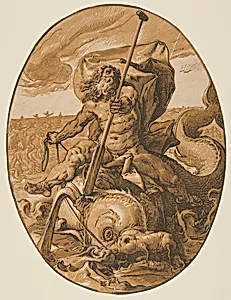
Oceanus, from The Deities
1588/90
Medium
Chiaroscuro woodcut from three blocks in tan and ochre on ivory laid paper
Dimensions
Sheet: 35 × 26.4 cm (13 13/16 × 10 7/16 in.)
Classification
Department
Prints and Drawings
Museum
Art Institute of Chicago
Accession Number
268528
Rights
Public Domain
Art Historical Context
Behold *Oceanus, from The Deities*, a chiaroscuro woodcut Hendrick Goltzius created around 1588–90. This print depicts the mythological Titan Oceanus, the ancient Greek god embodying the vast, encircling river-ocean, rendered with dynamic energy amid swirling waves and muscular form. Goltzius, a Dutch engraver and innovator of Northern Mannerism, produced this as part of his celebrated series *The Deities*, which brought classical gods to life through prints accessible to collectors across Europe. The artwork's medium—a chiaroscuro woodcut from three blocks in tan and ochre on ivory laid paper—demonstrates Goltzius's technical brilliance. Chiaroscuro, meaning "light-dark" in Italian, uses multiple blocks to create tonal depth and subtle color gradations, mimicking the dramatic lighting of oil paintings in a print format. Measuring 35 × 26.4 cm, this intimate sheet exemplifies late 16th-century advances in woodblock printing, rivaling engraving's precision and expanding printmaking's expressive potential. Housed in the Art Institute of Chicago's Prints and Drawings department, *Oceanus* highlights Goltzius's influence on Renaissance print culture, blending mythological grandeur with innovative craft. Visitors will appreciate how it captures the era's fascination with antiquity, making divine power vividly tangible on paper.
About the Artist
Hendrick Goltzius · 1558–1617
Hendrick Goltzius (1558–1617) was the most celebrated engraver of the Northern Renaissance and a pivotal figure in Dutch Mannerism. Born near the German-Dutch border, Goltzius transformed printmaking into a virtuoso art form through his revolutionary 'swelling line' technique, where the burin was manipulated to create lines of varying thickness that produced unprecedented tonal effects and three-d...