
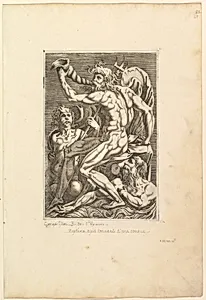
Neptune Seated Blowing a Conch Shell
Medium
Engraving
Dimensions
plate: 9 3/16 x 6 3/8 in. (23.4 x 16.2 cm) platemark sheet: 16 1/16 x 10 7/8 in. (40.8 x 27.6 cm)
Classification
Prints
Department
Drawings and Prints
Museum
Metropolitan Museum of Art, New York, NY
Credit
Harris Brisbane Dick Fund, 1926
Accession Number
26.50.1(78)
Rights
Public Domain
Tags
Art Historical Context
In the grand tradition of Renaissance printmaking, *Neptune Seated B a Conch Shell* the mighty Roman god of the sea in a poised, muscular pose, his cheeks puffed as he sounds his conch-shell trumpet. Attributed to engravers Giorgio Ghisi andino del Vaga ( known as Pietro Buonacc), or an anonymous 16th-century artist, this work exemplifies the era's fascination with classical mythology. Produced in Italy during a time when humanism revived ancient gods, Neptune symbolizes the untamed power of the oceans, often depicted wielding the conch to summon storms or command marine creatures. Engraving, the medium here, was revolutionary in the 16th century, allowing intricate details—like the god's flowing beard, rippling waves, and textured shell—to be reproduced precisely from metal plates (measuring 9 3/16 x 6 3/8 inches). Ghisi, a master engraver, was renowned for translating paintings into prints, making elite art accessible to collectors across Europe. This technique not only preserved designs but fueled the spread of Mannerist styles, with their elegant, elongated forms. Housed in the Metropolitan Museum of Art's Drawings and Prints department (acquired via the Harris Brisbane Dick Fund in 1926), this print invites visitors to ponder Neptune's enduring cultural role—from Virgil's epics to modern sea lore—reminding us how 16th-century artists bridged antiquity and the Renaissance world.
About the Artist
Giorgio Ghisi|Perino del Vaga (Pietro Buonaccorsi)|Anonymous, 16th century · 1520–1582
Giorgio Ghisi (c. 1520–1582) was one of the most accomplished engravers of the Italian Renaissance, renowned for translating the monumental compositions of Raphael, Giulio Romano, and Michelangelo into the exacting medium of the burin. Born in Mantua, he trained in an environment shaped by the legacy of Giulio Romano's decoration of the Palazzo del Te, and the grandeur of that Mannerist tradition ...