
Netsuke
Unknown Artist
19th century
Medium
Ivory
Dimensions
H. 1 1/8 in. (2.9 cm); W. 1 1/2 in. (3.8 cm)
Classification
Netsuke
Culture & Period
Japan · Edo (1615–1868) or Meiji period (1868–1912)
Department
Asian Art
Museum
Metropolitan Museum of Art, New York, NY
Credit
Gift of Mrs. Russell Sage, 1910
Accession Number
10.211.423
Rights
Public Domain
Tags
Art Historical Context
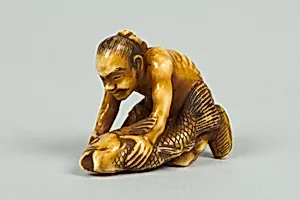
This charming ivory netsuke, carved in 19th-century Japan during the late Edo (1615–1868) or early Me (1868–1912) period, captures a lively scene of a man and fish. Measuring just 1 1/8 inches high and 1 1/2 inches wide, its miniature scale exemplifies the netsuke's role as a practical yet artistic accessory—a toggle used to secure inro (small medicine boxes or pouches) to a kimono sash, as traditional garments lacked pockets. Netsuke like this one highlight Japan's masterful tradition of ivory carving, where artisans employed fine tools to render intricate details, such as the textured scales of fish and expressive human features, all in a material prized for its creamy smoothness and workability. Popular among samurai, merchants, and collectors, these carvings often featured whimsical or everyday motifs, blending functionality with humor or symbolism—here, perhaps evoking abundance or the joys of fishing. A gift to the Metropolitan Museum of Art from Mrs. Russell Sage in 1910, this piece reflects the global fascination with Japanese art during the late 19th century, when netsuke became coveted exports. Its survival showcases the enduring appeal of Edo-Meiji craftsmanship, inviting us to marvel at artistry in the tiniest forms.