
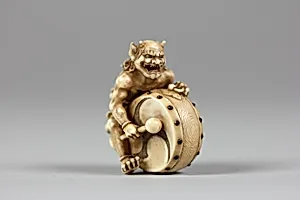
Netsuke of Demon with a Drum
Unknown Artist
18th–19th century
Medium
Ivory
Dimensions
H. 1 3/4 in. (4.4 cm); W. 1 1/2 in. (3.8 cm); D. 1 1/8 in. (2.9 cm)
Classification
Netsuke
Culture & Period
Japan · Edo (1615–1868) or Meiji period (1868–1912)
Department
Asian Art
Museum
Metropolitan Museum of Art, New York, NY
Credit
Gift of Mrs. Russell Sage, 1910
Accession Number
10.211.603
Rights
Public Domain
Tags
Art Historical Context
This exquisite ivory netsuke, in Japan during the Edo Meiji period, exemplifies remarkable artistry of miniature sculpture. Netsuke served as practical toggles, securing small pouches or cases to the sashes of traditional kimonos before pockets became common in Japanese clothing. Standing just under inches tall, this piece depicts a lively demon beating a drum, capturing a moment of dynamic energy in a compact form that could be appreciated through touch as well as sight. Carved from smooth ivory with fine attention to detail, the work reflects the high level of skill among anonymous artisans who elevated these functional objects into collectible treasures. Demons, or oni, frequently appear in Japanese folklore as mischievous or protective figures, and their pairing with a drum may evoke festive rituals or thunderous sounds from popular tales. Such motifs added layers of cultural meaning, blending utility with storytelling. Acquired by the Metropolitan Museum through a generous gift in 1910, this netsuke highlights how everyday items from 18th- and 19th-century Japan became enduring symbols of craftsmanship and imagination. Its small scale invites close viewing, revealing the intricate balance between form and function that defines this art form.