
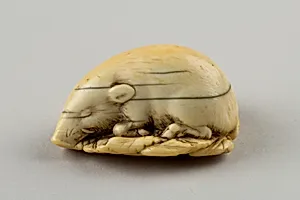
Netsuke of a Boar
Unknown Artist
18th century
Medium
Ivory
Dimensions
H. 1 1/16 in. (2.7 cm); W. 2 1/16 in. (5.2 cm)
Classification
Netsuke
Culture
Japan
Department
Asian Art
Museum
Metropolitan Museum of Art, New York, NY
Credit
Gift of Alvin H. Schechter, 1985
Accession Number
1985.399.11
Rights
Public Domain
Tags
Art Historical Context
This exquisite *Netsuke of a Boar*, carved in the 18th century during Japan's Edo period, exemplifies the masterful artistry of netsuke—tiny toggles designed to secure inro (small medicine cases) or pouches to a kimono sash. Measuring just 1 1/16 inches high and 2 1/16 inches wide, these-sized sculptures were both functional and ornamental, reflecting the era's blend of everyday utility and refined craftsmanship. Produced by an unknown artist, it hails from Japan's vibrant Asian Art tradition and entered the Metropolitan Museum of Art a gift from Alvin H. Schechter in 1985. Crafted from ivory, the boar is rendered with remarkable detail, capturing the animal's muscular form, bristly hide, and curved tusks through precise carving techniques. Ivory's smooth, workable quality allowed artisans to achieve lifelike textures on such a minuscule scale, showcasing the technical virtuosity prized in netsuke making. In Japanese culture, the boar symbolizes strength, ferocity, and perseverance, often evoking the wild boars of folklore and their association with warriors or protective spirits. As a cultural artifact, this netsuke offers a window into 18th-century Japan's aesthetic world, where everyday objects became miniature masterpieces. Visitors to the Met can appreciate how these charms bridged practicality and artistry, delighting collectors worldwide.