
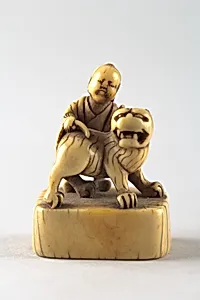
Netsuke of Boy with Dog
Unknown Artist
19th century
Medium
Ivory
Dimensions
H. 1 3/16 in. (4.6 cm); W. 1 3/8 in. (3.5 cm); D. 1 in. (2.5 cm)
Classification
Netsuke
Culture & Period
Japan · Edo (1615–1868) or Meiji period (1868–1912)
Department
Asian Art
Museum
Metropolitan Museum of Art, New York, NY
Credit
Gift of Mrs. Russell Sage, 1910
Accession Number
10.211.1084
Rights
Public Domain
Tags
Art Historical Context
This delightful netsuke, titled *Boy with Dog*, is a example of 19th-century Japanese craftsmanship from the Asian Art collection at the Metropolitan Museum of Art Carved from ivory, it measures just 1 3/16 inches high, embodying the intricate miniaturism prized in netsuke—small toggles worn on kimono sashes to secure inro pouches or tobacco cases, as traditional garments lacked pockets. Donated in 1910 by Mrs. Sage, this pocket-sized sculpture captures a playful boy cradling a loyal pup, evoking everyday joys in Edo-period (1615–1868) or early Meiji-era (1868–1912) life. Netsuke flourished during these dynamic periods, when Japan's ukiyo-e "floating world" culture celebrated whimsy and realism in miniature form. Ivory, valued for its smooth carvability and warm glow, allowed artisans to render fine details like the boy's tousled hair, expressive face, and the dog's alert ears and curled tail. Though the artist remains unknown, the piece reflects the virtuoso techniques of professional netsuke-carvers, who often drew from folklore and nature for talismanic appeal—dogs symbolizing fidelity and protection in Japanese lore. Today, this netsuke invites us to marvel at Japan's artistic ingenuity, blending utility with storytelling in a form that once dangled from samurai belts or merchant sashes, now preserved as a cultural treasure.