
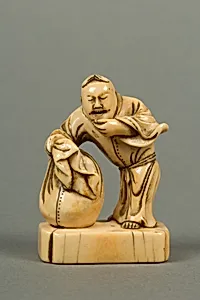
Netsuke of Man with a Bag, Standing on a Block
Unknown Artist
19th century
Medium
Ivory
Dimensions
H. 1 5/8 in. (4.1 cm); W. 1 1/8 in. (2.9 cm); D. 3/4 in. (1.9 cm)
Classification
Netsuke
Culture & Period
Japan · Edo (1615–1868) or Meiji period (1868–1912)
Department
Asian Art
Museum
Metropolitan Museum of Art, New York, NY
Credit
Gift of Mrs. Russell Sage, 1910
Accession Number
10.211.391
Rights
Public Domain
Tags
Art Historical Context
This exquisite netsuke, titled *Man with a Bag, on a Block*, is tiny masterpiece of Japanese craftsmanship from the 19 century, likely from the late Edo period (1615–1868) or early Meiji era (1868–1912). Carved from ivory, it measures just 1 5/8 inches high, capturing a standing man clutching a bag atop a sturdy block. Its diminutive scale—barely larger than a walnut—highlights the artist's remarkable precision in rendering human form and everyday details. Netsuke like this served a practical purpose in traditional Japanese dress: as toggles to secure inro (small lacquered cases) or pouches to the kimono sash, since belts lacked loops. Emerging in the 17th century, they evolved into coveted art objects, blending functionality with whimsy. This piece reflects Edo-Meiji urban culture, where such carvings depicted merchants, travelers, or laborers, evoking the bustling life of old Japan. Housed in the Metropolitan Museum of Art's Asian Art Department since 1910, thanks to a gift from Mrs. Russell Sage, the netsuke showcases ivory's smooth, warm translucency—ideal for intricate low-relief work. Though the artist remains unknown, its survival underscores netsuke's enduring appeal as pocket-sized portals to Japan's artistic heritage.