
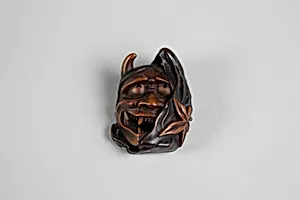
Netsuke of Demon Mask
Unknown Artist
19th century
Medium
Wood
Dimensions
H. 1 7/8 in. (4.8 cm); W. 1 1/2 in. (3.8 cm); D. 1 in. (2.5 cm)
Classification
Netsuke
Culture & Period
Japan · Edo (1615–1868) or Meiji period (1868–1912)
Department
Asian Art
Museum
Metropolitan Museum of Art, New York, NY
Credit
Gift of Mrs. Russell Sage, 1910
Accession Number
10.211.2387
Rights
Public Domain
Tags
Art Historical Context
This exquisite wooden netsuke, carved in 19th-century Japan during the late Edo or early Meiji period, represents a fierce demon mask, or oni. Netsuke served as practical toggles, securing small pouches or inro containers to a kimono sash traditional Japanese garments lacked pockets. Despite its modest size—less than two inches tall—the piece showcases the remarkable skill of anonymous artisans who transformed everyday functional objects into miniature sculptures. Demon imagery held deep cultural resonance in Japanese folklore, symbolizing protection against evil while evoking the dramatic masks of Noh theater. The unknown carver likely used fine chisels and polishing techniques to capture the mask’s menacing expression in wood, a medium prized for its warmth and ability to hold intricate detail. Such works highlight the blend of utility and artistry that defined netsuke during a time of social change and growing international interest in Japanese crafts. Acquired by the Metropolitan Museum through a generous gift in 1910, this netsuke offers visitors a glimpse into the refined tastes and storytelling traditions of 19th-century Japan.