
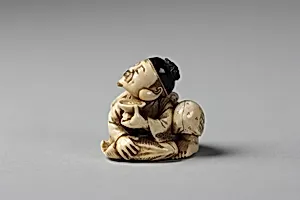
Netsuke of Ebisu
Unknown Artist
18th century
Medium
Ivory
Dimensions
H. 1 1/2 in. (3.8 cm); W. 1 3/8 in. (3.5 cm); D. 1 1/4 in. (3.2 cm)
Classification
Netsuke
Culture & Period
Japan · Edo period (1615–1868)
Department
Asian Art
Museum
Metropolitan Museum of Art, New York, NY
Credit
Gift of Mrs. Russell Sage, 1910
Accession Number
10.211.348
Rights
Public Domain
Tags
Art Historical Context
This exquisite Netsuke of Ebisu, from ivory in 18th-century Japan during the Edo (1615–1868), captures the whimsical charm of one of the Seven Gods. Standing just 1 1/2 inches tall, this tiny toggle depicts Ebisu, the deity of prosperity, fishermen, and merchants, often portrayed with his signature attributes like a fish or bamboo hat—hallmarks of his joyful, benevolent spirit. Its compact dimensions (H. 1 1/2 in.; W. 1 3/8 in.; D. 1 1/4 in.) highlight the netsuke's practical role as a functional ornament. Netsuke emerged in Edo Japan as ingenious accessories to secure inro (small medicine or tobacco pouches) to kimono sashes, blending utility with artistry. Crafted by unknown artisans from precious ivory, these miniature sculptures demanded masterful techniques like intricate undercutting and polishing to achieve lifelike detail and smooth tactility. Ebisu's portrayal reflects the period's popular devotion to the Seven Gods of Fortune, symbols of good luck amid urban prosperity. A gift to the Metropolitan Museum of Art from Mrs. Russell Sage in 1910, this piece now graces the Asian Art department, offering visitors a tactile glimpse into Japan's rich tradition of pocket sculpture. Handle with care—its delicacy invites wonder at the skill of long-lost hands.