
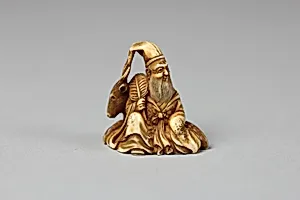
Netsuke of Fukurokojin
Unknown Artist
19th century
Medium
Ivory
Dimensions
H. 1 3/8 in. (3.5 cm); W. 1 1/4 in. (3.2 cm); D. 3/4 in. (1.9 cm)
Classification
Netsuke
Culture & Period
Japan · Edo (1615–1868) or Meiji period (1868–1912)
Department
Asian Art
Museum
Metropolitan Museum of Art, New York, NY
Credit
Gift of Mrs. Russell Sage, 1910
Accession Number
10.211.374
Rights
Public Domain
Tags
Art Historical Context
This delicate ivory netsuke, titled *Netsuke of Fukurokojin portrays a robed male figure from Japanese, likely representing Fukurokuju—one of the Seven Lucky GodsShichifukujin) symbolizing wealth, happiness, and longevity. Carved by an unknown artist in the19th century during Japan's Edo (1615–1868) or Meiji (1868–1912) period, it stands just 1 3/8 inches (3.5 cm) tall, exemplifying the miniaturist's precision in capturing expressive features and flowing robes within a compact form. Netsuke like this served a practical purpose in traditional Japanese attire: as toggles to secure small pouches or inro (lacquered boxes) to a kimono sash, since pockets were absent from garments. Ivory, prized for its smooth carvability and luminous quality, allowed artisans to render fine details—such as textured fabrics and subtle facial expressions—making these objects both functional and talismanic, often evoking good fortune through divine subjects. Now in the Metropolitan Museum of Art's Asian Art Department, this piece was a gift from Mrs. Russell Sage in 1910. It reflects the Edo-Meiji era's flourishing netsuke tradition, blending everyday utility with cultural reverence for luck-bringing deities, offering visitors a tangible glimpse into Japan's artistic ingenuity.