
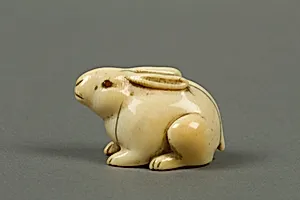
Netsuke of Rabbit
Unknown Artist
19th century
Medium
Ivory
Dimensions
H. 1 in. (2.5 cm); W. 1 1/2 in. (3.8 cm); D. 1 in. (2.5 cm)
Classification
Netsuke
Culture & Period
Japan · Edo (1615–1868) or Meiji period (1868–1912)
Department
Asian Art
Museum
Metropolitan Museum of Art, New York, NY
Credit
Gift of Mrs. Russell Sage, 1910
Accession Number
10.211.10
Rights
Public Domain
Tags
Art Historical Context
This delightful *Netsuke of Rabbit carved from ivory in 19th-century Japan, exemplifies the exquisite craftsmanship of Edo (1615–1868) or early Meiji (1868–1912) period artisans. Measuring just 1 inch high, 1½ inches wide, and 1 inch deep, petite scale belies the intricate detailing possible in ivory—a prized medium for its smooth carvability and luminous quality. Unknown artists like this one transformed everyday toggles into wearable sculptures, securing inro (small medicine or tobacco pouches) to kimono sashes in a pocketless era. Netsuke were more than functional; they were status symbols and conversation pieces, often depicting animals like rabbits, which evoked folklore ties to the moon and prosperity. The carver's skill shines in the rabbit's alert posture and textured fur, achieved through precise himotoshi (cord holes) and subtle undercutting techniques. Collected avidly by Westerners in the late 19th century, this piece entered the Metropolitan Museum of Art as a gift from Mrs. Russell Sage in 1910, preserving a slice of Japan's artistic ingenuity. Visitors, imagine slipping this tiny treasure onto your belt— a bridge between utility and whimsy in feudal Japan!