
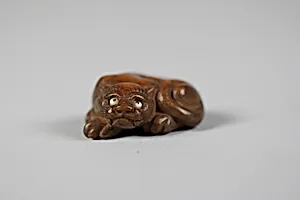
Netsuke of Recumbent Tiger
Unknown Artist
19th century
Medium
Boxwood
Dimensions
L. 1 1/3 in. (3.4 cm)
Classification
Netsuke
Culture
Japan
Department
Asian Art
Museum
Metropolitan Museum of Art, New York, NY
Credit
The Lesley and Emma Sheafer Collection, Bequest of Emma A. Sheafer, 1973
Accession Number
1974.356.71
Rights
Public Domain
Tags
Art Historical Context
Nestled in the Metropolitan Museum of Art's Asian Art collection this exquisite *Netsuke of Recumbent Tiger* from19th-century Japan exemplifies the mastery of miniature sculpture. Netsuke were practical yet artistic toggles, securing inro pouches—small lacquered cases for medicines or seals—to traditional kimono sashes during the Edo period (160–1868) and into the Meiji era. Carved from boxwood, a dense hardwood prized for its fine grain and creamy patina, this piece measures just 1 1/3 inches (3.4 cm) long, showcasing the carver's skill in capturing lifelike detail on an intimate scale. The recumbent tiger, lounging with poised relaxation, embodies the animal's revered symbolism in Japanese culture as a fierce protector and emblem of power and autumn winds. Unknown artisans like this one employed hōgyoku techniques—polishing to a glossy finish—allowing the wood's natural veins to enhance the tiger's fur and musculature. Such netsuke blurred the line between utility and high art, often collected by samurai and merchants alike. A generous bequest from the Lesley and Emma Sheafer Collection in 1973, this netsuke invites visitors to marvel at Japan's Edo-era ingenuity, where everyday objects became portals to folklore and craftsmanship.