
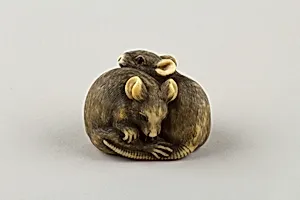
Netsuke of Two Rats
early 19th century
Medium
Ivory, horn
Dimensions
H. 1 in. (2.5 cm); W. 1 9/16 in. (4 cm)
Classification
Netsuke
Culture
Japan
Department
Asian Art
Museum
Metropolitan Museum of Art, New York, NY
Credit
Gift of Alvin H. Schechter, 1985
Accession Number
1985.399.7
Rights
Public Domain
Tags
Art Historical Context
This delightful *Netsuke of Two Rats* by the Japanese artist Okatori, carved in the early 19th century, exemplifies exquisite miniature sculptures that defined Edo-period Japan. Crafted from ivory and horn, it measures just 1 inch high and 1 9/16 inches wide—perfectly pocket-sized. Netsuke like this served a practical purpose: as toggles to secure inro (small lacquered pouches) to a kimono sash, blending utility with artistry during a time when pockets were absent from traditional clothing. Okatori's masterful carving captures two playful rats in dynamic interplay, their fur textured with fine incisions and horn accents adding realistic sheen to eyes or whiskers. Ivory's creamy smoothness allowed for such intricate detailing, a hallmark of netsuke craftsmanship that elevated everyday objects into wearable art. Rats, often symbols of cleverness and prosperity in Japanese folklore (linked to the zodiac), infuse the piece with whimsy and cultural resonance. A gift to the Metropolitan Museum of Art in 1985 from Alvin H. Schechter, this netsuke highlights the global fascination with Japan's ukiyo-e-inspired decorative arts. Visitors can marvel at how such tiny works encapsulate the period's ingenuity and joy in the miniature.