
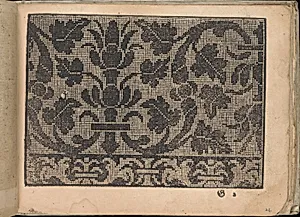
Neu künstlich Modelbuch (page 26r)
1598 (?)
Medium
Woodcut
Dimensions
Overall: 6 1/8 x 7 7/8 in. (15.5 x 20 cm)
Classification
Books|Prints|Ornament & Architecture
Department
Drawings and Prints
Museum
Metropolitan Museum of Art, New York, NY
Credit
Gift of Mary M. Greenwood, in memory of Eliza Rudd Greenwood, 1953
Accession Number
53.566.1(26r)
Rights
Public Domain
Tags
Art Historical Context
Step into the intricate world of Renaissance craftsmanship with *Neu künstlich Modelbuch (page 26r) by Bernhard Jobin, Strasbourg printer whose innovative pattern books from around 1598 revolutionized design dissemination. This woodcut page, measuring a compact 6 1/8 x 7 7/8 inches, showcases delicate floral motifs—likely blooming tendrils and blossoms—perfectly suited for artisans copying patterns onto textiles, woodwork, or metalwork. Printed via woodcut, a labor-intensive relief technique where intricate designs were carved into wooden blocks and inked for multiple impressions, Jobin's work exemplifies late 16th-century Northern European printing prowess. Modelbücher like this "New Artistic Pattern Book" bridged art and craft, spreading ornate styles from the Holy Roman Empire across Europe, blending naturalism with fantastical ornamentation influenced by Renaissance humanism and earlier grotesques. Housed in the Metropolitan Museum of Art's Drawings and Prints department (gift of Mary M. Greenwood, 1953), this page highlights the era's cultural emphasis on symmetry and nature-inspired decoration, fueling the decorative arts boom. Imagine 400 years ago, embroiderers and carvers poring over such pages to adorn homes and churches—timeless blueprints of beauty in bloom.
About the Artist
Bernhard Jobin · 1535–1597
Bernhard Jobin, born before 1545 in Porrentruy in the Swiss canton of Jura, emerged as a pivotal figure in the Strasbourg printing world. Trained as a Formschneider—a skilled woodblock cutter—he acquired Strasbourg citizenship in 1560 as a typesetter and joined the printers' guild, marking the start of his professional ascent. In 1567, he married Anna Fischart, sister of the renowned writer Johann...