
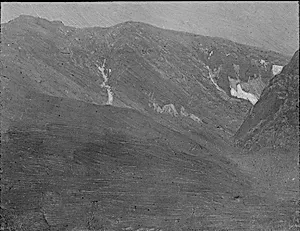
New England, White Mountains
Classification
Painting
Department
Smithsonian Collection
Museum
Smithsonian American Art Museum
Credit
Hirshhorn Museum and Sculpture Garden, Smithsonian Institution, Washington, DC, Gift of Joseph H. Hirshhorn, 1966
Accession Number
66.504
Rights
Public Domain
About this artwork
Florence Lewison Gallery, New York, to 1963
Art Historical Context
Albert Bierstadt's *New England, White Mountains* (1857–1862) captures the majestic allure of New Hampshire's rugged peaks during mid-19th century, a time when American artists were championing the nation's natural wonders through the Hudson River School movement. Born in Germany but raised in New Bedford, Massachusetts, Bierstadt honed his skills sketching in the White Mountains, one of the East Coast's most celebrated wilderness areas. This luminist-inspired painting reflects his early mastery of dramatic light and vast scale, evoking the Romantic sublime that inspired awe and national pride amid rapid industrialization. As a cornerstone of American landscape art, the work exemplifies Bierstadt's technique of meticulous detail and glowing atmospheres, often achieved through oil on canvas—though the exact medium here remains unspecified. It predates his famed expeditions to the Rocky Mountains, showcasing his ability to transform familiar terrain into epic vistas that symbolized Manifest Destiny and the untamed American spirit. Acquired from Florence Lewison Gallery in New York by 1963 and gifted to the Hirshhorn Museum and Sculpture Garden in 1966, this piece now graces the Smithsonian American Art Museum, inviting visitors to ponder the enduring romance of New England's wild heart.