
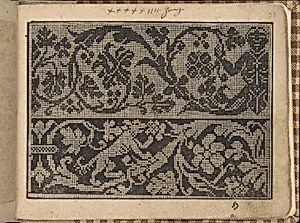
New Künstlichs Modelbuch (Page 29 recto)
1600
Medium
Woodcut
Dimensions
Overall: 6 5/16 x 8 1/4 in. (16 x 21 cm)
Classification
Books|Prints|Ornament & Architecture
Department
Drawings and Prints
Museum
Metropolitan Museum of Art, New York, NY
Credit
Rogers Fund, 1919
Accession Number
19.158(29r)
Rights
Public Domain
Tags
Art Historical Context
Step into the intricate world of Renaissance craftsmanship with *New Künstlichs Model (Page 29 recto)*, a woodcut print by Bernhard Jobin from 1600. Published in, this page is part of a celebrated pattern book—or *Modelbuch*—designed a visual treasury for artisans like goldsmiths, engr, and embroiderers Jobin, a skilled German printer, crafted these affordable woodcuts to inspire and standardize decorative motifs across Europe. Woodcuts, carved into wooden blocks and inked for multiple impressions, were revolutionary for their reproducibility, democratizing complex designs during the late Renaissance. This 6 5/16 x 8 1/4-inch page bursts with Jobin's signature ornamental flair: intertwined human figures, playful animals, and blooming flowers form elegant, fantastical patterns ready for adaptation into jewelry, textiles, or architecture. Acquired by The Metropolitan Museum of Art through the Rogers Fund in 1919, this work highlights the era's fusion of art and utility. It reveals how pattern books fueled the spread of Northern Mannerist styles, blending natural forms with imaginative symmetry to influence workshops from Germany to beyond. A delightful glimpse into the creative spark of 17th-century design!
About the Artist
Bernhard Jobin · 1535–1597
Bernhard Jobin, born before 1545 in Porrentruy in the Swiss canton of Jura, emerged as a pivotal figure in the Strasbourg printing world. Trained as a Formschneider—a skilled woodblock cutter—he acquired Strasbourg citizenship in 1560 as a typesetter and joined the printers' guild, marking the start of his professional ascent. In 1567, he married Anna Fischart, sister of the renowned writer Johann...