
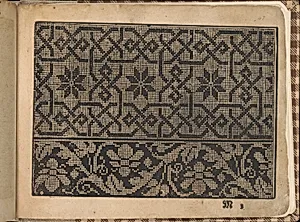
New Künstlichs Modelbuch (Page 47 recto)
1600
Medium
Woodcut
Dimensions
Overall: 6 5/16 x 8 1/4 in. (16 x 21 cm)
Classification
Books|Prints|Ornament & Architecture
Department
Drawings and Prints
Museum
Metropolitan Museum of Art, New York, NY
Credit
Rogers Fund, 1919
Accession Number
19.158(47r)
Rights
Public Domain
Tags
Art Historical Context
Step into the intricate world of Renaissance ornamentation with *New Künstlichs Model (Page 47 recto)*, a woodcut print by Strasbourg goldsmith and engraver Bernhard Jobin created in 1600. just 6 5/16 x 8 1/4 inches, this page Jobin's innovative pattern book showcases delicate floral motifs, exemplifying the era's fascination with nature-inspired designs. Housed in The Metropolitan Museum of Art's Drawings and Prints department (quired through the Rogers Fund in 9), it belongs to a tradition of *Modelbücher*—practical manuals that disseminated ornamental patterns across Europe. Jobin's work reflects the late Northern Renaissance, where woodcuts enabled affordable reproduction of complex designs for artisans in metalwork, textiles, and architecture. These books bridged fine art and craft, allowing goldsmiths like Jobin to share *künstlich* (artistic) inventions that blended symmetry, scrolling vines, and blooming flowers into harmonious compositions. Page 47 recto likely features such floral elements, tagged for their botanical elegance, which influenced decorative arts from jewelry to bookbindings. This modest yet masterful page highlights how pattern books fueled the spread of stylistic uniformity in the decorative arts, making high-level ornament accessible to workshops far beyond Strasbourg. A testament to Jobin's skill, it invites us to appreciate the hidden artistry behind everyday Renaissance beauty.
About the Artist
Bernhard Jobin · 1535–1597
Bernhard Jobin, born before 1545 in Porrentruy in the Swiss canton of Jura, emerged as a pivotal figure in the Strasbourg printing world. Trained as a Formschneider—a skilled woodblock cutter—he acquired Strasbourg citizenship in 1560 as a typesetter and joined the printers' guild, marking the start of his professional ascent. In 1567, he married Anna Fischart, sister of the renowned writer Johann...