
New Year Gift: Incense Spoon
A.D. 1913; original ca. 1427–1400 B.C.
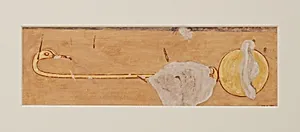
Medium
Tempera on paper
Dimensions
H. 7.5 cm (2 15/16 in); w. 24.5 cm (9 5/8 in), scale 1:1; framed with 30.4.177 and .179
Classification
Facsimile, Qenamun (TT 93), incense spoon; Drink-and-be-Merry; New-Year-Gift2
Period
Twentieth Century; original New Kingdom
Department
Egyptian Art
Museum
Metropolitan Museum of Art, New York, NY
Credit
Rogers Fund, 1930
Accession Number
30.4.180
Rights
Public Domain
Tags
Art Historical Context
This delicate tempera-on-paper facsimile captures an ancient Egyptian incense spoon created as a New Year gift during Dynasty 18 of the New Kingdom, around 1427–1400 B.C. Norman de Garis Davies, a pioneering Egyptologist and artist, produced the copy in 1913 at actual size to preserve the original’s intricate details for modern study. Such spoons, often inscribed with wishes for health and prosperity, were offered during festive celebrations that blended ritual and merriment, as hinted by the work’s evocative “Drink-and-Be-Merry” association. Davies’s meticulous technique reflects the early twentieth-century practice of creating accurate reproductions to document fragile artifacts before widespread photography. Working in tempera allowed him to faithfully render the spoon’s carved forms and hieroglyphs, ensuring that the symbolic motifs—likely evoking renewal and abundance—remained accessible to scholars and the public alike. Housed in the Metropolitan Museum’s Egyptian Art department, this small yet significant piece (just 7.5 cm high) bridges millennia, inviting visitors to appreciate both the ingenuity of New Kingdom artisans and the dedicated efforts of later copyists who safeguarded Egypt’s visual heritage.
About the Artist
Norman de Garis Davies · 1865–1941
Norman de Garis Davies (1865–1941) was a British Egyptologist and archaeological artist whose meticulous copies of ancient Egyptian tomb paintings constitute one of the most important records of pharaonic art ever made. Born in Ashton-under-Lyne, Lancashire, he originally trained for the ministry before being drawn into Egyptology through his involvement with the Egypt Exploration Fund in the 1890...