
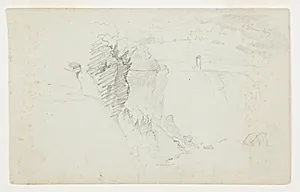
Niagara Falls from the American Side, New York
Classification
landscapes
Department
Smithsonian Collection
Museum
Smithsonian American Art Museum
Credit
Gift of Louis P. Church
Accession Number
1917-4-149-a
Rights
Public Domain
About this artwork
Research in Progress
Art Historical Context
Frederic Edwin Church, a leading American landscape painter active in the mid-19th century, created this 1856 depiction of Niagara Falls viewed from the American side. As a central figure in the Hudson River School movement, Church specialized in grand, meticulously observed scenes of nature that celebrated the American wilderness with a sense of awe and national pride. His works often highlighted dramatic natural phenomena, making Niagara—a site of growing cultural significance—a fitting subject during an era when the falls symbolized the sublime power and beauty of the young United States. This landscape reflects the period's romantic fascination with untamed scenery, as artists like Church sought to document and elevate America's unique geography amid rapid industrialization and tourism. Though the specific medium is unknown, the painting's classification as a landscape underscores Church's mastery in conveying scale, light, and atmosphere to immerse viewers in the scene. Gifted to the Smithsonian American Art Museum by Louis P. Church, it forms part of a vital collection preserving 19th-century American artistic heritage. Church's approach combined precise detail with emotional resonance, inviting contemplation of nature's majesty and humanity's place within it. This work continues to engage audiences with its portrayal of one of North America's most iconic natural wonders.