
Niagara
Medium
oil on canvas
Dimensions
overall: 101.6 × 229.9 cm (40 × 90 1/2 in.) framed: 164.5 × 286.4 × 17.8 cm (64 3/4 × 112 3/4 × 7 in.)
Classification
Painting
Department
CAB
Museum
National Gallery of Art, Washington, D.C.
Credit
Corcoran Collection (Museum Purchase, Gallery Fund)
Accession Number
2014.79.10
Rights
Public Domain
Art Historical Context
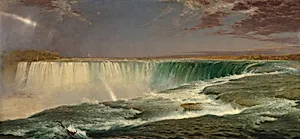
Frederic Edwin Church's *Niagara* (1857) is a monumental oil on canvas that captures the raw power and majesty of Niagara Falls a natural wonder straddling the U.S.-Canada border. a leading figure in the River School, Church specialized in luminous landscapes that celebrated America's wilderness, blending meticulous detail with romantic sublime effects. This panoramic work, measuring over 7 feet wide, immerses viewers in the thundering cascade, with sunlight piercing mist and rainbows arching dramatically—evoking awe and the divine in nature. Painted during a peak of American Romanticism, *Niagara* reflects mid-19th-century optimism and national pride amid westward expansion. Church sketched on-site before composing this studio masterpiece, employing precise brushwork for hyper-realistic textures: foaming waters, rocky ledges, and ethereal light. Exhibited widely upon completion, it drew massive crowds, affirming Church's celebrity status and the era's fascination with natural spectacles as symbols of divine providence. Today, in the National Gallery of Art's Corcoran Collection, *Niagara* endures as a testament to luminism's glowing realism, inviting visitors to ponder humanity's place amid untamed beauty.
About the Artist
Frederic Edwin Church · 1826–1900
Frederic Edwin Church (1826–1900), born in Hartford, Connecticut, to a prosperous silversmith and banker father, Joseph Church, pursued art from youth thanks to his family's wealth. At age 18, introduced by patron Daniel Wadsworth, he studied under Thomas Cole in Catskill, New York, from 1844 to 1846, sketching across New England and earning Cole's praise for possessing "the finest eye for drawing...