
Nicolas Brulart
1551 to 1600
Medium
engraving on laid paper
Dimensions
plate: 29.5 x 21.4 cm (11 5/8 x 8 7/16 in.) sheet: 37.2 x 26.5 cm (14 5/8 x 10 7/16 in.)
Classification
Department
CG-E
Museum
National Gallery of Art, Washington, D.C.
Credit
Gift of John O'Brien
Accession Number
1991.164.59
Rights
Public Domain
Art Historical Context
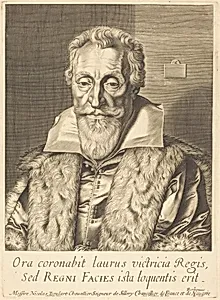
Behold the elegant portrait engraving *Nicolas Brulart* by Michel Lasne, masterful work from the late 16 century (circa 1551–1600). Lasne, a skilled French engraver, captures the dignified likeness of Nicolas Brulart—likely a prominent figure of the era, evoking the refined portraiture of the Renaissance. Measuring 29.5 x 21.4 cm on the plate, this print exemplifies the period's fascination with individualized likenesses, bridging painting and printmaking to make elite imagery accessible. Crafted as an engraving on laid paper—a traditional support with visible chain lines that lent texture and durability—Lasne employed the intaglio technique. He incised fine lines into a metal plate, inking the grooves and pressing them onto the dampened sheet for rich, velvety tones and precise detail. This method allowed for multiple impressions, democratizing high art during France's religious wars and cultural renaissance. Housed in the National Gallery of Art's Prints department (CG-E) through the generous gift of John O'Brien, this piece highlights engraving's role in preserving historical visages. It invites us to ponder Brulart's world, where such portraits affirmed status and legacy amid turbulent times. A gem for print enthusiasts! (198 words)
About the Artist
Michel Lasne · 1590–1667
Michel Lasne (ca. 1590–1667) was a French engraver, draughtsman, and collector who became one of the most prolific printmakers of the French Baroque period. Born in Caen around 1590, Lasne was the son of a goldsmith, which provided him with early exposure to metalworking techniques essential for engraving. His career spanned the reigns of Louis XIII and the early years of Louis XIV, during which h...