
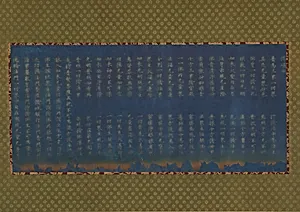
二月堂焼経|Nigatsudō Burned Sutra
ca. 744
Medium
Hanging scroll; silver ink on indigo-dyed paper
Dimensions
Overall with mounting: 41 3/4 × 26 1/2 in. (106 × 67.3 cm) Overall with knobs: 41 3/4 in. × 28 5/8 in. × 1 in. (106 × 72.7 × 2.5 cm) Image: 9 7/8 × 21 1/4 in. (25.1 × 54 cm)
Classification
Paintings
Culture & Period
Japan · Nara period (710–794)
Department
Asian Art
Museum
Metropolitan Museum of Art, New York, NY
Credit
Purchase, Mrs. Jackson Burke Gift, 1978
Accession Number
1981.75
Rights
Public Domain
Art Historical Context
Step into the serene world of Nara-period Japan (710–794) with *Nigatsudō Burned Sutra*, a rare hanging scroll created around 744 by an unidentified artist. This delicate work hails from the early days of Japanese Buddhism, when grand temples like Tōdai-ji flourished under imperial patronage. The title refers to Nigatsudō, the "Hall of the Second Month" at Tōdai-ji in Nara, famous for its ancient fire rituals. Miraculously, this sutra survived a devastating fire, earning its evocative name and symbolizing resilience and divine protection. Crafted on indigo-dyed paper—a vibrant blue achieved through natural fermentation of the Polygonum tinctorium plant—the scroll features elegant silver ink calligraphy. This luxurious medium, shimmering against the deep indigo ground, was reserved for sacred texts, highlighting the sutra's spiritual prestige. At just 9⅞ × 21¼ inches, the image area exemplifies early Japanese scroll formats, designed for intimate contemplation or ritual display. Housed in The Metropolitan Museum of Art's Asian Art Department since 1978, this treasure offers a glimpse into 8th-century devotional artistry. Its survival story underscores Buddhism's enduring role in Japanese culture, blending artistry, faith, and history in a single, luminous artifact.