
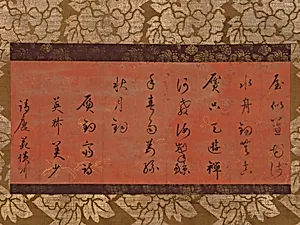
七言絶句|Chinese Poem on Fishing and Zen
late 15th century
Medium
Hanging scroll: ink on paper decorated in gold
Dimensions
Image: 8 5/8 × 19 11/16 in. (21.9 × 50 cm) Overall with mounting: 43 3/4 × 22 5/8 in. (111.1 × 57.5 cm)
Classification
Calligraphy
Culture & Period
Japan · Muromachi period (1392–1573)
Department
Asian Art
Museum
Metropolitan Museum of Art, New York, NY
Credit
Mary and Cheney Cowles Collection, Gift of Mary and Cheney Cowles, 2021
Accession Number
2021.398.11
Rights
Public Domain
Art Historical Context
In the serene elegance of the Muromachi period (1392–1573), Japanese Zen monk Osen Keisan (川景山) created this exquisite hanging scroll, *Seven-Character Quatrain: Chinese Poem on Fishing and*, around the late 15th century. Rendered in bold ink strokes on gold-flecked paper, the work measures 8⅝ × 19¹¹/₁₆ inches, designed to unfurl dramatically for contemplation or display. This classification as calligraphy highlights its dual role as poetry and visual art, a hallmark of Zen aesthetics where brushwork embodies spiritual discipline. The poem, a *qiyan jueju*—a concise Chinese verse form of four seven-character lines—meditates on fishing as a metaphor for Zen enlightenment, evoking quiet riverside introspection amid nature's rhythms. Muromachi-era Japan saw Zen Buddhism flourish under Ashikaga shoguns, fostering arts like this that blurred poetry, painting, and philosophy. Osen Keisan's vigorous yet fluid script reflects *kana* and kanji mastery, influenced by Song dynasty models, while the gold decoration adds a luminous, imperial touch rare in monastic works. Housed in the Metropolitan Museum of Art's Asian Art department, this scroll from the Mary and Cheney Cowles Collection invites visitors to pause, much like the fisherman-poet, tracing each stroke for its meditative depth and cultural resonance in Japan's ink tradition.