
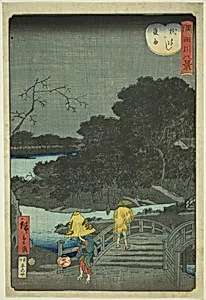
Night Rain at Makura Bridge (Makurabashi yau), from the series "Eight Views of the Sumida River (Sumidagawa hakkei)"
Medium
Color woodblock print; oban
Classification
woodblock print
Department
Arts of Asia
Museum
Art Institute of Chicago
Accession Number
26678
Rights
Public Domain
Art Historical Context
In the dim glow of lanterns piercing a curtain of night rain, Utagawa Hirosh II (Shigenobu) captures the poetic melancholy of urban life in *Night Rain at Makura BridgeMakurabashi yau)*, from his 1861 series *Eight Views of Sumida River (Sumidagawa hakkei. As the adopted son and prized pupil of the legendary Hiroshige I, Shigenobu carried forward the ukiyo-e of woodblock prints, blending everyday scenes with lyrical beauty. This oban-sized color woodblock print, held in the Art Institute of Chicago's Arts of Asia collection, evokes the bustling yet introspective world of late Edo-period Tokyo (then Edo) along the vital Sumida River. Hiroshige II masterfully employs the woodblock technique—carving intricate blocks for each color layer—to render the slick sheen of rain-swept pavements, the hazy silhouettes of figures under umbrellas, and the bridge's arch against a stormy sky. These "eight views" homage classic Chinese landscape motifs while grounding them in familiar Japanese locales, transforming the ordinary into the sublime. Culturally, such prints democratized art, adorning homes of merchants and commoners alike. Created amid Japan's final years of isolation before the Meiji era, this work reflects ukiyo-e's fading golden age, preserving fleeting moments of beauty amid encroaching modernity. A rainy stroll here feels timelessly immersive.
About the Artist
Utagawa Hiroshige II (Shigenobu) · 1826–1869
Utagawa Hiroshige II, born Suzuki Chinpei in 1826, was one of the most accomplished ukiyo-e artists of mid-nineteenth century Japan. He entered the studio of the celebrated landscape master Utagawa Hiroshige I — known for his iconic series "The Fifty-three Stations of the Tokaido" — and proved himself the most talented of the elder artist's few students. So highly regarded was the young pupil that...