
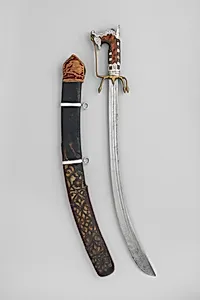
Nimcha (Saber) with Scabbard
Unknown Artist
hilt and scabbard, late 17th or early 18th century; blade 16th or 17th century
Medium
Steel, silver, copper, wood, tortoiseshell, horn, mother-of-pearl, leather, textile
Dimensions
L. without scabbard 26 3/8 in. (67 cm); L. of blade 21 in. (53.3 cm); Wt. 1 lb. 6 oz. (632 g); Wt. of scabbard 9 oz. (263 g)
Classification
Swords
Culture
hilt and scabbard, Algerian; blade, European
Department
Arms and Armor
Museum
Metropolitan Museum of Art, New York, NY
Credit
Bequest of George C. Stone, 1935
Accession Number
36.25.1550a, b
Rights
Public Domain
Art Historical Context
Behold the elegant Nimcha saber with its scabbard, a masterful blend of North African craftsmanship and European blade-making from the Metropolitan Museum of Art's Arms and Armor collection. to the late 17th or early 18th century for the hilt and scabbard with a 16th- or 17th-century blade, this weapon measures 26⅜ inches overall (blade 21 inches) and weighs just over a pound—light yet lethal for swift combat. Its hilt and sheath dazzle with opulent materials: steel forged for the curved blade, silver and copper accents, tortoiseshell, horn, mother-of-pearl inlays, wood, leather, and textile wrappings, evoking the luxury of a warrior elite. The Nimcha, a hallmark of Algerian sword design, reflects the vibrant cultural exchanges across the Mediterranean during the Ottoman era in North Africa. The imported European blade, likely from Italy or Spain, paired with local embellishments, underscores trade networks and the adaptation of foreign technology for regional warfare—think Barbary corsairs raiding European ships. These sabers were not mere tools but status symbols, their intricate inlays showcasing artisanal skill in damascening and mosaic work. Bequeathed by George C. Stone in 1935, this piece invites us to ponder the artistry in arms: where form meets function in a dance of steel and splendor, bridging continents and centuries.